
Cloud Security is a Boardroom Issue
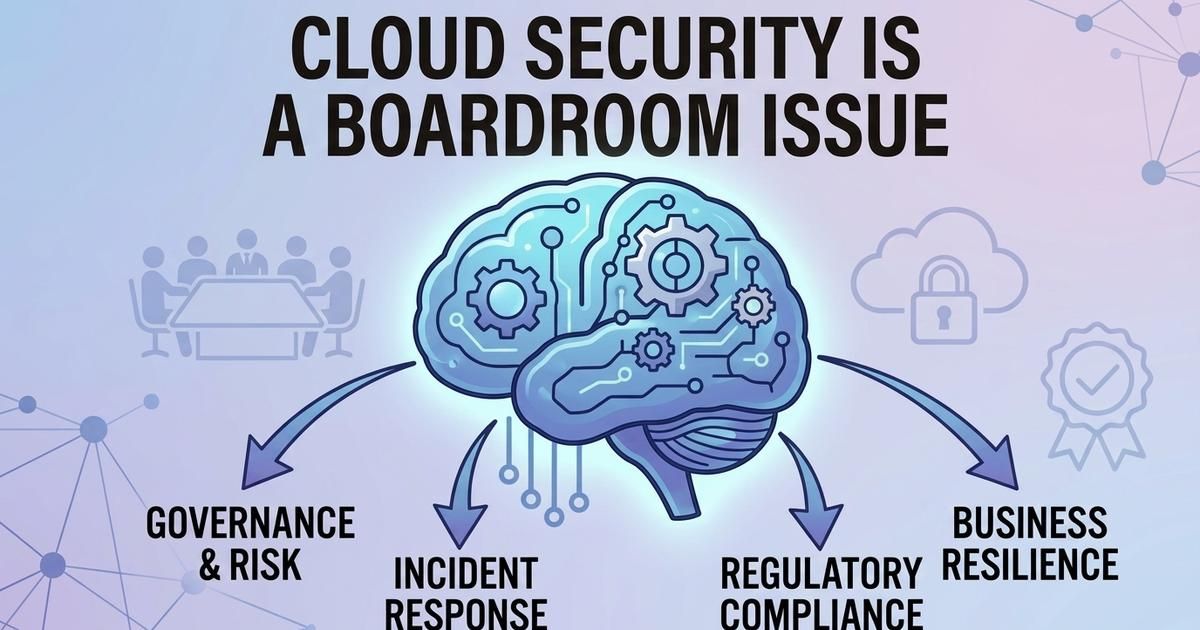

Cloud Security Isn't IT's Problem Alone — It's a Boardroom Issue
Gartner has predicted that 99% of cloud security failures will be the customer's fault — not the cloud provider's, and overwhelmingly due to misconfiguration rather than sophisticated attack techniques. That statistic reframes the entire conversation: this isn't primarily a technology risk. It's a governance and accountability risk sitting inside your own organization.
Want to know where your organization's cloud security governance actually stands?
Cloud security incidents are often discussed in the language of external threats — sophisticated attackers, zero-day vulnerabilities, nation-state actors. The data tells a more uncomfortable story for leadership: the overwhelming majority of cloud security failures trace back to preventable misconfigurations and identity mismanagement inside the organization itself, not to attacker sophistication. This is precisely why cloud security belongs in a boardroom risk conversation rather than being treated as a purely technical operational matter delegated entirely to IT.
Stats That Matter
- Cloud security incidents affected 65% of organizations in 2025, and Gartner projects that 99% of cloud security failures through this period will be the customer's fault, overwhelmingly due to misconfiguration.
- A single misconfigured cloud asset can expose millions of records, and roughly 70% of misconfigurations remain undetected for weeks or months before being exploited — a detection gap, not just a prevention gap.
- Breaches spanning multiple environments (cloud, on-premises, and SaaS together) cost an average of $5.05 million and take the longest to contain of any breach category, at 276 days on average.
Why "It's the Customer's Fault" Is the Most Important Finding, Not the Most Damning
It would be easy to read the finding that most cloud security failures are the customer's fault as an indictment of individual IT teams. The more useful reading for leadership is the opposite: if the overwhelming majority of failures come from misconfiguration rather than external attacker sophistication, that means the overwhelming majority of these failures are preventable through better internal governance, not through buying more advanced security technology. This is a genuinely encouraging finding once reframed correctly — the risk is largely within the organization's own control.
The corollary is less comfortable: an organization that hasn't built strong internal cloud governance practices isn't primarily exposed to sophisticated external threats it can't control — it's exposed to its own preventable process gaps, which is a much harder finding to explain away in a board meeting after an incident.
Why This Compounds With the Multi-Cloud and AI Trends Covered Elsewhere in This Series
Cloud security risk doesn't exist in isolation from the other structural shifts covered elsewhere in this series. The move toward multi-cloud architectures, largely driven by the vendor risk concerns discussed previously, introduces genuine security complexity: a significant share of organizations report real difficulty maintaining consistent security controls across multiple cloud providers, and a comparable share lack the specialized staff needed to manage multi-cloud security effectively. The very strategy adopted to reduce vendor risk can inadvertently increase security risk if governance isn't built to span multiple environments consistently.
Similarly, the AI infrastructure growth discussed in the context of cloud cost management introduces new identity and access surfaces — new service accounts, new API integrations, new data pathways — each of which is a fresh opportunity for the kind of misconfiguration that dominates the breach statistics. Growth in cloud complexity from any direction tends to outpace security governance unless that governance is deliberately built to scale alongside it.
Why Detection Speed Matters as Much as Prevention
A finding that deserves specific leadership attention: a large majority of misconfigurations sit undetected for weeks or months before being exploited. This means the gap isn't only about preventing mistakes — mistakes are inevitable at scale — it's about how quickly an organization can detect and correct a misconfiguration before it becomes an actual breach. An organization with strong detection capability can catch and fix a misconfiguration within hours or days; an organization without it may not discover the same gap until an attacker already has.
This reframes the security investment conversation for leadership: spending exclusively on prevention while under-investing in continuous monitoring and detection leaves a wide window during which a preventable mistake sits exposed, waiting to be found by whichever party — internal audit or external attacker — happens to look first.
The Identity Shift Leadership Needs to Understand
The nature of cloud attacks has shifted meaningfully in recent years, and this shift has direct implications for where security investment should be prioritized. A growing majority of cloud breaches are now projected to originate from compromised identities — stolen or misused credentials and excessive access permissions — rather than from unpatched software vulnerabilities, which was the dominant pattern in earlier years. This means traditional security thinking centered on patching and perimeter defense addresses a shrinking share of the actual risk, while identity and access governance — who has access to what, and whether that access is continuously verified rather than granted once and forgotten — addresses a growing share of it.
Organizations investing primarily in the security patterns that mattered several years ago risk under-protecting against the pattern that dominates today.
What Leadership Should Actually Ask
Do we have continuous monitoring for misconfiguration, or do we rely on periodic manual reviews? Given how long misconfigurations typically sit undetected, continuous, automated detection is the difference between catching a mistake in hours versus discovering it after exploitation.
Is our identity and access governance keeping pace with our cloud complexity, especially across multiple providers and growing AI infrastructure? As access surfaces multiply, identity governance needs to scale proportionally, or it becomes the weakest link regardless of how strong other defenses are.
What is our actual exposure time if a misconfiguration occurs — hours, or months? This single question, more than any specific tool or vendor decision, indicates whether an organization's cloud security posture matches the current threat pattern or is still built around an outdated one.
Is cloud security governance a board-level risk item, or does it only surface after an incident? Given that the majority of failures are internally preventable governance issues, this is squarely the kind of risk that deserves standing visibility at the leadership level, not just reactive attention when something goes wrong.
Key Takeaways
- The overwhelming majority of cloud security failures stem from preventable internal misconfiguration and identity mismanagement, not sophisticated external attacks — meaning the risk is largely within the organization's own control.
- Multi-cloud and growing AI infrastructure both expand the identity and configuration surface that needs consistent governance, and complexity growth tends to outpace security practices unless deliberately managed.
- A large majority of misconfigurations go undetected for weeks or months, making detection speed as important as prevention in limiting actual exposure.
- Cloud breach patterns have shifted meaningfully toward identity compromise rather than unpatched software vulnerabilities, requiring a corresponding shift in where security investment is prioritized.
- Given that most failures are internally preventable governance gaps, cloud security deserves standing board-level visibility rather than only surfacing reactively after an incident.
What to Do Next
If your organization doesn't have continuous monitoring for cloud misconfiguration, or identity governance hasn't kept pace with your cloud and AI complexity, that gap is exactly where the next preventable incident is most likely to originate.
I work with a trainer who specializes in exactly this: helping leadership and technical teams build the cloud security governance practices that turn preventable risk into managed risk. If this is on your radar for the next quarter, call or contact me and I'll help you get started.